
Perimenopause explained: what to expect and how to manage it
Perimenopause is the transitional phase before menopause when fluctuating and falling levels of oestrogen and progesterone cause menstrual changes alongside symptoms such as hot flushes, sleep disruption and mood shifts. If any of this sounds familiar, two things are worth doing now: start tracking your periods and symptoms in a diary, and speak to your GP if you’re experiencing heavy or unusual bleeding, or if symptoms are significantly disrupting your daily life. NHS guidance, NICE clinical recommendations, the British Menopause Society, and Kate Grosvenor Lifestyle all offer clear, evidence-informed support to help you move through this transition with knowledge and calm.
Two things to do right now:
- Track your cycles and symptoms. Note cycle length, flow intensity, and any new symptoms each month. Patterns matter more than single readings.
- Contact your GP if you have very heavy bleeding, pass large clots, bleed after sex, or if symptoms are severely affecting your sleep, mood or daily function.
Many women experience hot flushes during this transition, and for many the symptoms begin years before periods stop. You are not imagining it, and you are far from alone.
Table of Contents
- What is perimenopause, and how does it differ from menopause?
- When does perimenopause start, and how long does it last?
- What are the symptoms of perimenopause?
- Why do these symptoms happen? The hormonal story
- How is perimenopause diagnosed?
- When should you contact a GP?
- What treatment options are available in the UK?
- Self-care and lifestyle measures that ease symptoms
- Fertility and contraception during perimenopause
- Longer-term health after perimenopause
- Evidence-backed supplements and how they can support you
- Key takeaways
- A note from Kate Grosvenor
- Supporting your symptoms with Kate Grosvenor Lifestyle
- Useful sources and further reading
What is perimenopause, and how does it differ from menopause?
Perimenopause literally means “around menopause.” It is the years-long transition during which your ovaries gradually produce less oestrogen and progesterone, your cycles become irregular, and the classic symptoms of the menopause transition begin to appear. Menopause itself is a single point in time: the moment you have gone 12 consecutive months without a period. Everything before that marker is perimenopause; everything after is post-menopause.
It helps to see the three stages as a sequence:
- Premenopause: your reproductive years before any hormonal shift begins. Cycles are broadly regular and hormone levels are relatively stable.
- Perimenopause: the transition phase. Hormones fluctuate unpredictably, cycles change, and symptoms emerge. This can last anywhere from two to eight years.
- Menopause: confirmed only in retrospect, after 12 full months without any bleeding or spotting.
The distinction between perimenopause and menopause matters practically. Many women assume they have reached menopause when their periods become infrequent, but until that 12-month marker is reached, ovulation can still occur and pregnancy remains possible. Knowing where you are in the sequence shapes every decision, from contraception to treatment.
When does perimenopause start, and how long does it last?
For most women, perimenopause begins in the mid-to-late 40s, though the range is wider than many expect. On average, the transition lasts about four years, though some women move through it in two years and others experience symptoms for up to eight.
Several factors can shift the timing earlier or later:
- Surgical menopause: removal of both ovaries (bilateral oophorectomy) brings on menopause immediately, regardless of age.
- Primary ovarian insufficiency (POI): when the ovaries stop functioning normally before age 40, causing early perimenopause or premature menopause.
- Smoking: associated with an earlier transition, sometimes by one to two years.
- Certain medical treatments: chemotherapy and pelvic radiotherapy can affect ovarian function and trigger early perimenopause.
- Family history: the age your mother reached menopause is one of the strongest predictors of your own timing.
- Later onset: some women do not notice perimenopausal changes until their early 50s, which is equally normal.
If your periods stop before age 45, or before 40 in particular, speak to your GP. Early menopause carries specific health implications for bone and cardiovascular health that are worth addressing promptly.
What are the symptoms of perimenopause?
The most common early sign is a change in your menstrual pattern, but perimenopause touches almost every system in the body. Symptoms vary widely in type, timing and intensity, and they can appear gradually or arrive quite suddenly.
Period changes
- Cycles that are longer, shorter, heavier or lighter than your usual pattern
- Skipped periods followed by a return of bleeding
- Spotting between periods or after sex (always report this to your GP)
Hot flushes and night sweats
A sudden wave of heat, usually across the face, neck and chest, often followed by sweating and a chill. Many women experience hot flushes, and they can persist for years after the final period.

Sleep problems
Difficulty falling asleep, waking in the night (often triggered by night sweats), and unrefreshing sleep are all common. Poor sleep then amplifies mood and cognitive symptoms, creating a cycle that can feel relentless.
Mood and cognitive changes
Anxiety, low mood, irritability and a sense of feeling unlike yourself. These shifts are driven by hormonal changes but are often deepened by fatigue, life pressures and, for some women, a history of PMS or postnatal depression. Brain fog, difficulty concentrating and memory lapses are also frequently reported.
Vaginal and urinary changes
Vaginal dryness, discomfort during sex, and increased urinary urgency or frequency. These symptoms tend to worsen over time rather than improve without treatment, so it is worth raising them with your GP sooner rather than later.

Sexual function
Reduced libido, longer time to arousal, and discomfort during intercourse. These changes are common and treatable; they do not have to be accepted as permanent.
Body, skin and hair changes
Weight redistribution (particularly around the abdomen), skin that feels drier or thinner, hair thinning or increased shedding, and changes in body odour. Some women also notice joint aches and breast tenderness.
Symptom diagnostic markers
| Marker | Clinical significance |
|---|---|
| Cycles varying by several days | Early indicator of perimenopause onset |
| Skipping 60+ days between periods | Indicates later-stage perimenopause transition |
| Hot flushes lasting beyond 12 months | Common; may persist for years after the final period |
| Vaginal dryness with no other cause | Suggests declining oestrogen; warrants GP discussion |
Pro Tip: When you track your cycle for a GP appointment, go beyond just dates. Note flow intensity (light, moderate, heavy), any spotting, and which symptoms appeared on which days. Clinicians find objective cycle records far more useful than general impressions, and a clear pattern can speed up your diagnosis considerably.
Why do these symptoms happen? The hormonal story
Perimenopause symptoms arise because your ovaries are producing oestrogen and progesterone in increasingly irregular and eventually declining amounts, and because ovulation becomes less predictable.
- Oestrogen regulates body temperature, mood, sleep, vaginal tissue, skin and bone density. As levels fluctuate and fall, almost every system that relies on oestrogen is affected.
- Progesterone is produced after ovulation and helps regulate the menstrual cycle and sleep. When ovulation becomes irregular, progesterone production drops, which disrupts cycle length and can worsen sleep and anxiety.
- Irregular ovulation is the engine of cycle change. Some months you ovulate normally; others you do not. This unpredictability is why cycles become erratic and why hormone blood tests taken at a single point in time are so hard to interpret.
Think of it less as a switch being turned off and more as a dimmer dial that moves unevenly, sometimes brighter, sometimes dimmer, before settling at a lower level. That variability is what makes perimenopause feel so unpredictable.
How is perimenopause diagnosed?
Diagnosis is usually clinical, based on your age, your menstrual history and your symptoms. There is no single blood test that confirms perimenopause, because hormone levels fluctuate too unpredictably to give a reliable reading at any one moment.
Your GP may consider the following tests in specific circumstances:
- FSH (follicle-stimulating hormone): may be measured if early menopause is suspected (before age 45), but a single reading is rarely conclusive.
- Thyroid function test: thyroid conditions can mimic perimenopausal symptoms, so ruling them out is often a sensible first step.
- Pregnancy test: if your periods are irregular but have not stopped, pregnancy remains possible and should be excluded.
For most women in their mid-40s with characteristic symptoms, a GP will diagnose perimenopause on clinical grounds without blood tests. The NHS does not routinely recommend hormone testing for women over 45 with typical symptoms.
What to bring to your GP appointment:
- A cycle diary covering at least two to three months (dates, flow, any spotting)
- A symptom log noting frequency and severity of hot flushes, sleep problems, mood changes
- A list of current medications and any supplements you are taking
- Any questions about treatment options you would like to discuss
When should you contact a GP?
See your GP promptly if you experience any of the following:
- Very heavy bleeding — soaking through a pad or tampon every hour for two or more consecutive hours
- Passing large clots — particularly if this is new or worsening
- Bleeding after sex or between periods that is not explained by a known cause
- Any vaginal bleeding after menopause (12 months without a period) — this always needs investigation
- Sudden, severe symptoms — rapid weight loss, fainting, severe pelvic pain
- Symptoms that severely disrupt daily life — sleep, work, relationships or mental health
Your GP may arrange blood tests, a pelvic examination, or an ultrasound scan depending on your symptoms. In some cases, referral to a gynaecologist or a specialist menopause clinic may be appropriate. Do not wait and hope these symptoms settle on their own; early assessment protects your health and opens up treatment options.
What treatment options are available in the UK?
HRT (hormone replacement therapy) is the most effective treatment for hot flushes and many other perimenopausal symptoms, and the choice of type and form depends on your individual health history, whether your uterus is present, and your personal preferences.
Treatment comparison
| Approach | Main benefits | Common forms | Key considerations |
|---|---|---|---|
| Systemic HRT | Relieves hot flushes, sleep, mood, bone protection | Tablets, patches, gels, sprays | Progestogen required if uterus present; discuss risks with GP |
| Local vaginal oestrogen | Relieves dryness, discomfort, urinary symptoms | Cream, pessary, ring, gel | Low systemic absorption; generally safe long-term |
| Non-hormonal medicines | Reduces hot flush frequency and severity | SSRIs, gabapentin, oxybutynin, fezolinetant | Used when HRT unsuitable or not wanted |
| CBT and talking therapies | Improves mood, sleep, perceived impact of flushes | Individual or group sessions | Growing evidence base; no drug interactions |
| Lifestyle measures | Supports all symptoms; protects bone and heart | Exercise, diet, sleep hygiene, cooling strategies | First-line adjunct for all women |
HRT in more detail
Systemic HRT replaces falling oestrogen and, where needed, progesterone. If you have a uterus, taking oestrogen without progestogen raises the risk of endometrial cancer, so progestogen is always prescribed alongside it. Women who have had a hysterectomy can take oestrogen alone. Forms include daily tablets, transdermal patches (changed once or twice a week), gels or sprays applied to the skin, and the Mirena coil, which can provide the progestogen component locally.
NHS guidance recommends using the lowest effective dose for the shortest time that manages your symptoms, reviewed at least annually. The risks of HRT, including a small increased risk of breast cancer with combined HRT and a small risk of blood clots with oral oestrogen, need to be weighed against the benefits, which include relief of symptoms and protection against osteoporosis.
Non-hormonal options
SSRIs, gabapentin, oxybutynin and fezolinetant are all used when HRT is not suitable or not wanted. Fezolinetant works by acting on a brain pathway that regulates body temperature and is specifically licensed for hot flushes. Cognitive behavioural therapy (CBT) has a growing evidence base for reducing the perceived impact of hot flushes and improving sleep quality.
Questions to raise with your GP:
- Am I a good candidate for HRT given my health history?
- Which form of HRT would suit my lifestyle?
- How long should I expect to take it, and when will we review?
- What are my options if I prefer not to use hormones?
Self-care and lifestyle measures that ease symptoms
Lifestyle changes can meaningfully reduce symptom burden for many women, and they support the long-term health of your bones and heart regardless of whether you choose medical treatment.
Practical measures that help:
- Sleep routine: go to bed and wake at consistent times; keep the bedroom cool and dark. Weight-bearing exercise during the day improves sleep quality at night.
- Cooling strategies: lightweight, moisture-wicking or bamboo nightwear, a fan by the bed, and layered clothing during the day so you can adjust quickly.
- Exercise: aim for at least 150 minutes of moderate activity per week, including weight-bearing and resistance exercise for bone health.
- Diet: a balanced diet rich in calcium and vitamin D supports bone density; reducing processed foods and added sugar may help with weight management and energy.
- Alcohol and caffeine: both can trigger hot flushes and disrupt sleep. Even modest reductions often make a noticeable difference.
- Smoking: cessation reduces the risk of earlier menopause, cardiovascular disease and osteoporosis.
Pro Tip: For night sweats specifically, keep a small cool-water spray and a light bamboo sheet within reach. Waking, cooling down quickly, and returning to sleep without fully rousing is far easier when you have prepared the environment in advance. For more on managing sleep in perimenopause, the Kate Grosvenor Lifestyle blog has practical, non-medical strategies worth reading.
Lifestyle measures alone are often sufficient for women with mild symptoms. If symptoms are moderate to severe, or if they are significantly affecting your quality of life, medical treatment should be discussed with your GP rather than relying on lifestyle changes alone.
Fertility and contraception during perimenopause
You can still become pregnant during perimenopause. Even with irregular cycles, ovulation can still occur, and because it is impossible to predict when, an unplanned pregnancy remains a real possibility until menopause is confirmed.
Continue contraception until you have had 12 consecutive months without a period, unless your GP advises otherwise.
Contraception options commonly used in perimenopause:
- Progestogen-only pill (POP): suitable for most women; does not affect cardiovascular risk and can help with cycle regulation.
- Hormonal IUS (Mirena coil): provides contraception and, when combined with systemic oestrogen, can serve as the progestogen component of HRT. A practical dual-purpose option.
- Combined oral contraceptive pill: may help with heavy periods and hot flushes, but is not recommended for women who smoke or have cardiovascular risk factors.
- Barrier methods: condoms and diaphragms remain effective and carry no hormonal considerations.
- Copper IUD: non-hormonal; suitable for women who prefer to avoid hormones entirely.
If you are using hormonal contraception, it can mask the natural cycle changes of perimenopause, making it harder to know when menopause has occurred. Your GP can advise on when and how to transition from contraception to HRT if that is your goal.
Longer-term health after perimenopause
After menopause, falling oestrogen levels increase the risk of osteoporosis and cardiovascular disease. These risks can be managed with screening, lifestyle measures and, where appropriate, ongoing medical treatment.
Key long-term health checks:
- Bone health: a DEXA scan (bone density scan) may be recommended if you have risk factors for osteoporosis, including early menopause, low body weight, smoking history or a family history of fractures. Weight-bearing exercise and adequate calcium and vitamin D intake are protective at every stage.
- Cardiovascular risk assessment: your GP should review blood pressure, cholesterol and lifestyle factors regularly. The risk of heart disease rises after menopause, and early attention to modifiable risk factors makes a meaningful difference.
- Mental health review: anxiety and depression can persist or emerge post-menopause. If mood symptoms continue after periods stop, they deserve their own assessment and treatment, not just an assumption that they will resolve.
- Vaginal and urinary health: genitourinary syndrome of menopause (GSM) — dryness, discomfort, urinary urgency — often worsens without treatment. Local vaginal oestrogen is safe, effective and can be used long-term; it is worth asking your GP about it if you have not already.
Menopause is not an ending. With the right support, the years that follow can be among the most grounded and purposeful of your life.
Evidence-backed supplements and how they can support you
Supplements are supportive adjuncts to medical treatment and lifestyle measures, not replacements for them. The evidence base for individual supplements varies, and it is worth understanding what each one does and does not offer.
What the evidence suggests for key supplement categories:
- Omega-3 fatty acids: associated with cardiovascular and mood support. Some research suggests benefit for low mood and joint comfort during the menopause transition. Kate Grosvenor Lifestyle’s omega-3 for perimenopause is formulated specifically for this life stage.
- Vitamin B complex: B vitamins support energy metabolism and nervous system function. Fatigue and low mood during perimenopause may be partly related to B vitamin status. The brand’s vitamin B complex for perimenopause is designed with this in mind.
- Magnesium: supports sleep quality, muscle function and mood regulation. Many women find magnesium helpful for night-time restlessness and tension. Kate Grosvenor Lifestyle’s magnesium complex is formulated for perimenopausal support.
- Intimate flora: vaginal microbiome health can shift during perimenopause. Probiotic support for intimate flora may help maintain comfort and balance.
Hormone Balance & Mood Ritual
The Hormone Balance & Mood Ritual is Kate Grosvenor Lifestyle’s multi-ingredient supplement designed to support mood stability and hormonal balance during perimenopause. It is intended as a daily ritual that complements lifestyle measures and, where relevant, medical treatment. As with all supplements, it is not a substitute for HRT or other prescribed medicines.
PeriCool sage leaf cooling support
PeriCool is a sage-leaf based supplement designed to support the body’s response to hot flushes and night sweats. Sage has a long history of traditional use for these symptoms, though robust clinical trial evidence remains limited. It is best used alongside cooling lifestyle strategies rather than as a standalone solution.
Safety and interactions callout:
Herbal remedies, including sage, red clover and black cohosh, have limited reliable evidence and some may interact with prescription medicines or have effects on the liver. Always speak to your GP or pharmacist before starting any supplement, particularly if you are taking prescribed medication or have a liver condition.
How Kate Grosvenor Lifestyle approaches evidence: the brand reviews published research for each ingredient category and formulates products to support the specific needs of women aged 40–60. Supplements are positioned as part of a broader wellbeing approach, not as medical treatments. The evidence summaries above reflect the current state of research, including its limits.
Pro Tip: If you are considering supplements alongside HRT or other prescribed medicines, bring a full list of everything you are taking to your next GP or pharmacist appointment. Some herbal ingredients interact with medicines in ways that are not always obvious, and a quick check takes only a moment.
Key takeaways
Perimenopause is a years-long hormonal transition that begins, for most women, in the mid-to-late 40s, and it is both diagnosable and manageable with the right support.
| Point | Details |
|---|---|
| Perimenopause age range | Most women notice changes in their mid-to-late 40s; the transition typically lasts about four years, with a range of two to eight years. |
| Symptom recognition | Period changes, hot flushes, sleep disruption, mood shifts and vaginal dryness are the most common signs; tracking them helps your GP. |
| Diagnosis is clinical | Blood tests are rarely definitive; your GP will usually diagnose on the basis of age, cycle history and symptoms. |
| When to see a GP | Heavy bleeding, large clots, post-menopausal bleeding or severely disruptive symptoms all warrant prompt medical assessment. |
| Kate Grosvenor Lifestyle | The Hormone Balance & Mood Ritual and PeriCool offer supportive supplement options alongside lifestyle measures and medical treatment. |
A note from Kate Grosvenor
There is something I want you to hold onto as you read all of this: perimenopause is not a malfunction. It is a transition, and like all transitions, it asks something of you. It asks you to pay attention, to be a little gentler with yourself, and to seek the right support rather than simply push through.
What I have seen, time and again, is that women arrive at this stage of life with very little preparation and a great deal of confusion. The symptoms are real. The hormonal shifts are real. And the relief that comes from understanding what is happening, and knowing that there are genuine options, is also real.
At Kate Grosvenor Lifestyle, we believe that the Renewal Years deserve the same care and attention as any other chapter. The Hormone Balance & Mood Ritual and PeriCool were developed as part of that belief: not as quick fixes, but as thoughtful daily rituals that sit alongside good medical care and a life lived with intention. If you are still finding your footing, that is exactly where you are supposed to be. The ground steadies.
Supporting your symptoms with Kate Grosvenor Lifestyle
If you are looking for a calm, considered place to start, Kate Grosvenor Lifestyle offers two supplements designed specifically for the symptoms that tend to feel most relentless.
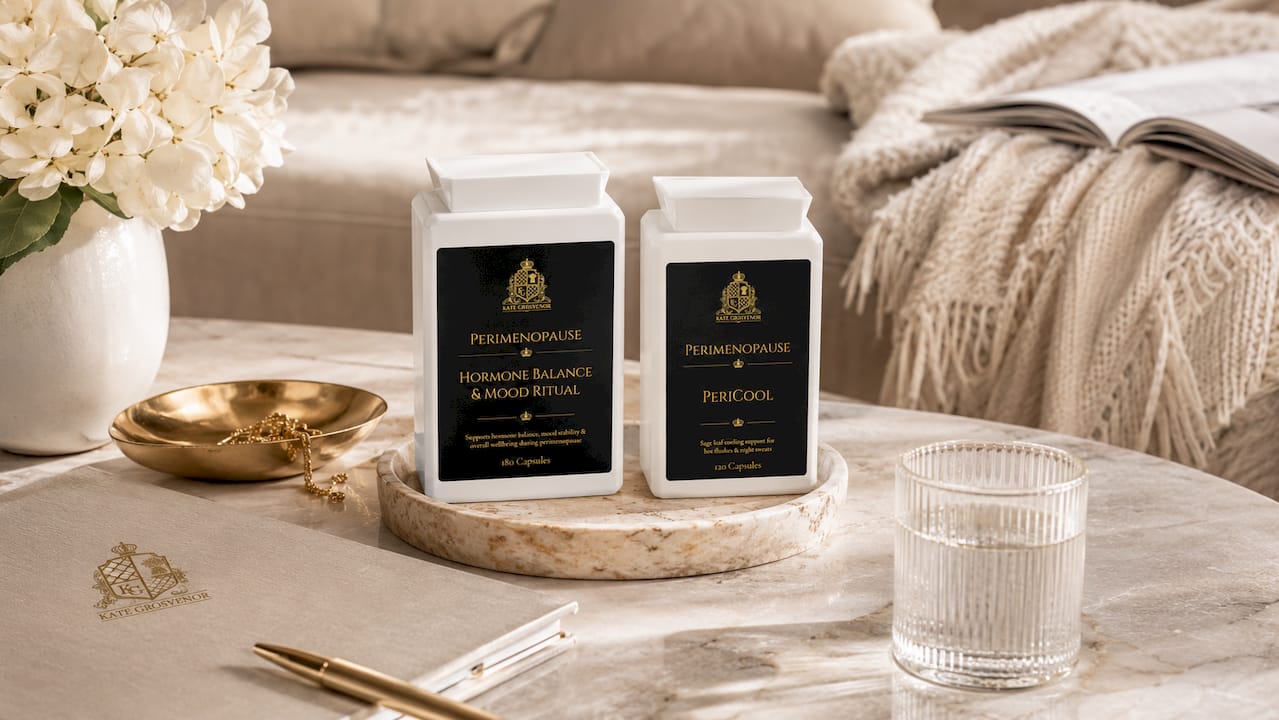
The Hormone Balance & Mood Ritual is a daily supplement ritual formulated to support mood, hormonal balance and energy during perimenopause. It works best as part of a broader approach: good sleep habits, regular movement, a nourishing diet, and, where appropriate, medical treatment discussed with your GP.
PeriCool pairs sage leaf with a cooling lifestyle strategy to support your body’s response to hot flushes and night sweats. Use it alongside breathable nightwear, a cool bedroom environment, and the other practical measures described in this guide.
A note on safety: always consult your GP or pharmacist before adding any supplement to your routine, particularly if you are taking prescribed medicines. Supplements are supportive options, not replacements for medical treatment. If your symptoms are severe or significantly affecting your quality of life, please speak to your GP first.
Visit Kate Grosvenor Lifestyle to browse the full range of perimenopausal support, or speak to a clinician about which options are right for your situation.
This article is general information, not medical advice. Please confirm current guidance with your GP, pharmacist or a qualified clinician for your own situation.
Useful sources and further reading
These are the primary sources used in this article, all of which offer reliable, evidence-based information for UK readers:
- NHS: Symptoms of menopause and perimenopause — the NHS patient guide covering the full range of symptoms; a clear, trustworthy starting point.
- NHS: Treatment for menopause and perimenopause — covers HRT types, non-hormonal options, herbal remedies and safety considerations; essential reading before a GP appointment.
- British Menopause Society — the UK’s leading professional body for menopause care; publishes clinical guidelines and patient resources including a directory of menopause specialists.
- NICE guideline NG23: Menopause: diagnosis and management — the definitive UK clinical guideline; useful for understanding the evidence base behind treatment recommendations.
- Office on Women’s Health: Menopause basics — a well-structured US resource with clear explanations of the transition, symptoms and treatment; figures cited in this article are drawn from here.
- Menopause Society (formerly NAMS): Perimenopause patient education — detailed patient information on perimenopause, contraception and tracking; used for cycle-tracking and contraception guidance in this article.
- Mayo Clinic: Perimenopause symptoms and causes — reliable clinical overview including diagnostic markers for cycle changes.
- Kate Grosvenor Lifestyle: The UncompliKated Guide to Perimenopause — the brand’s own practical guidebook for women navigating perimenopause; a readable companion to the clinical sources above.



Leave a comment
This site is protected by hCaptcha and the hCaptcha Privacy Policy and Terms of Service apply.