
Can you take collagen and creatine together safely?
Yes, you can take collagen and creatine together. They are safe to combine, with no known interference in how either is absorbed or used by the body. They work through entirely different pathways, which is precisely why pairing them makes sense rather than creating any conflict.
Here is what that looks like in practice:
- Creatine: typically a common daily dose, often as creatine monohydrate powder
- Collagen: typically a common daily dose, usually as a hydrolysed collagen peptide powder
- Both can be mixed into the same drink or taken at separate times — whichever fits your routine
- No dose adjustment is needed when taking them together
- Certain groups, including those with kidney conditions and those who are pregnant or breastfeeding, should speak with a GP before starting either supplement
The rest of this guide explains what each supplement does, why combining them can be particularly supportive during midlife, and how to make both part of a calm, consistent daily ritual.
Table of Contents
- What creatine actually does for your body
- What collagen does and why it matters after 40
- The real benefits of taking collagen and creatine together
- How to take collagen and creatine together effectively
- Medical considerations for UK adults: when to seek advice first
- What the science says about combining these supplements
- Key takeaways
- Why this combination deserves more attention in midlife
- Collagen and creatine, thoughtfully formulated for midlife women
What creatine actually does for your body
Creatine is one of the most thoroughly researched supplements in existence. Your body produces it naturally, primarily in the liver and kidneys, and stores it in muscle tissue where it plays a direct role in producing adenosine triphosphate (ATP), the molecule your cells use for energy.

When you supplement with creatine, you gradually saturate your muscle stores over several weeks. This means the benefits build steadily rather than arriving overnight. Patience and consistency are the real ingredients here.
Key benefits of creatine supplementation include:
- Muscle strength and power: supports short bursts of effort, from lifting to climbing stairs with more ease
- Physical performance: helps muscles work harder before fatigue sets in
- Recovery support: may reduce muscle soreness after exercise
- Cognitive support: emerging research suggests creatine may support brain energy, which is particularly relevant during perimenopause when mental clarity can feel elusive
- Lean muscle maintenance: supports the preservation of muscle mass, which naturally declines from the mid-thirties onwards
Creatine monohydrate is the gold standard form, with the most robust body of research behind it. A typical maintenance daily dose is standard; a loading phase is optional and not necessary for long-term results. For midlife women, where muscle mass and energy are both under pressure, creatine is quietly one of the most useful supplements available.
What collagen does and why it matters after 40
Collagen is the most abundant protein in the human body. It forms the structural scaffolding of your skin, tendons, ligaments, cartilage, and bones, holding everything together with quiet, steady strength. From your mid-twenties, your body’s natural collagen production begins to decline. By the time perimenopause arrives, that decline accelerates, driven in part by falling oestrogen levels.

Supplementing with hydrolysed collagen peptides gives your body the amino acid building blocks it needs to support its own repair processes. Research supports doses of 10–20g daily for connective tissue benefits and recovery support, with many studies using a 10–15g range as a practical starting point.
What collagen supplementation can support:
- Skin hydration and elasticity: one of the most studied and visible benefits, particularly relevant for women in their forties and fifties
- Joint comfort: supports cartilage integrity, which can ease the aching joints that often accompany hormonal shifts
- Tendon and ligament resilience: helps connective tissue adapt to physical demands
- Bone density support: collagen forms the protein matrix within bone, making it relevant alongside calcium and vitamin D
- Recovery after exercise: connective tissue repair is slower than muscle repair, and collagen provides targeted support
Unlike whey or plant proteins, collagen is not a complete protein — it lacks tryptophan. So it works best alongside other protein sources rather than as a replacement for them. Think of it as a specialist, not a generalist.
The real benefits of taking collagen and creatine together
Creatine and collagen are not competing for the same role. They complement each other in a way that is particularly meaningful for anyone who is active, ageing, or both.
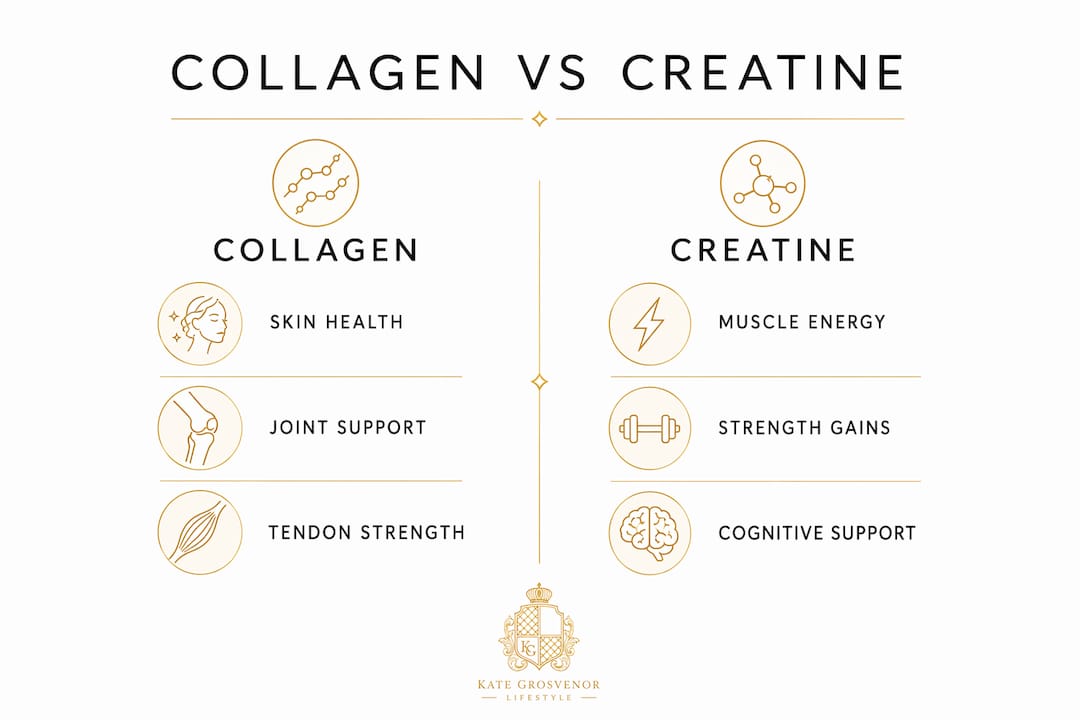
Creatine supports the muscle side of the equation: energy production, strength, and performance. Collagen supports the connective tissue side: the tendons, ligaments, and cartilage that allow your muscles to actually do their work without breaking down. When you build or maintain muscle with creatine, your connective tissues need to keep pace. Collagen helps them do exactly that.
The combined benefits include:
- Improved muscle recovery: creatine reduces muscle fatigue; collagen supports tissue repair
- Reduced injury risk: stronger connective tissue means less vulnerability when you push yourself physically
- Joint health during active ageing: both supplements address different aspects of the same challenge
- Skin and muscle support simultaneously: a combination that makes particular sense for women in their Renewal Years
- Sustained physical confidence: feeling stronger and more comfortable in your body, day to day
A common myth is that taking two supplements together somehow dilutes their individual effects. There is no evidence for this with collagen and creatine. Neither interferes with the other’s absorption or mechanism.
Pro Tip: Consistency matters far more than timing. Both supplements accumulate their benefits over weeks of daily use. Pick a time that fits naturally into your morning or evening ritual and keep it steady, rather than worrying about the precise hour.
How to take collagen and creatine together effectively
One of the most reassuring things about this combination is its flexibility. Because collagen and creatine are absorbed through different pathways, timing is not critical. You do not need to separate them, take them with specific foods, or follow a rigid schedule. What matters is that you take them daily.
Suggested approach:
- Creatine dose: 3–5g daily (one level teaspoon of creatine monohydrate)
- Collagen dose: 10–15g daily (one to two scoops of hydrolysed collagen peptides)
- Mix both into the same drink if you prefer — a morning smoothie, warm oat milk, or a simple glass of juice all work well
- Alternatively, take them at different points in the day if that suits your rhythm better
Managing side effects:
Creatine can cause minor side effects in some people, including temporary water retention and occasional digestive discomfort. Starting with a lower dose (around 2–3g) for the first week and building up gradually tends to ease this. Collagen is generally very well tolerated.
Pro Tip: Both creatine and collagen dissolve far better in warm or room-temperature liquids than in cold ones. Use a shaker bottle or a milk frother rather than a fork — you will get a smoother, more pleasant drink with no gritty residue at the bottom.
Medical considerations for UK adults: when to seek advice first
Most healthy adults can begin taking collagen and creatine without any specific medical clearance. That said, there are circumstances where a conversation with your GP or a registered nutritionist is the right first step.
Before starting creatine or collagen supplementation, speak with your GP if you:
- Have a diagnosed kidney condition or reduced kidney function, as creatine increases the metabolic load on the kidneys
- Are pregnant or breastfeeding, since supplement safety in these periods requires individual assessment
- Take prescription medications that may interact with supplements — including diuretics, NSAIDs, or blood pressure medication
- Have a history of liver conditions or metabolic disorders
The NHS recommends approaching any new supplement with the same care as a new medication when a health condition is present. Personalised advice from a healthcare professional is always the clearest path.
If you are managing multiple supplements or medications, a structured approach to tracking interactions can help you and your GP have a more informed conversation. A medical planner can also be a calm, practical way to keep your supplement routine organised and ready to share at appointments.
What the science says about combining these supplements
The evidence base for both supplements individually is well established. Creatine monohydrate has decades of clinical research behind it, and a 2022 review published in Nutrients examined creatine’s broader health benefits beyond sport, including its relevance for older adults and cognitive function. The findings support its use as a safe, effective supplement across a wide range of populations.
Collagen’s evidence base has grown considerably over the past decade. Cleveland Clinic notes that hydrolysed collagen peptides are absorbed efficiently and that supplementation can support skin, joint, and connective tissue health. UCLA Health similarly observes that collagen supplements show genuine promise for joint comfort and skin elasticity, particularly as natural production declines with age.
On the question of combining them: no clinical evidence suggests any negative interaction. The two supplements operate on separate biological systems, and the practical consensus among nutrition researchers is that they are complementary rather than competitive. For midlife women specifically, where both muscle maintenance and connective tissue integrity are under pressure simultaneously, the combination addresses two real and distinct needs at once.
The science does not demand a complex protocol. It simply asks for daily consistency, appropriate doses, and a little patience while the benefits accumulate quietly in the background.
Key takeaways
Taking collagen and creatine together is safe, well-supported by research, and particularly beneficial for midlife adults managing muscle health, joint comfort, and skin vitality simultaneously.
| Point | Details |
|---|---|
| Safe to combine | Collagen and creatine do not interfere with each other’s absorption or effectiveness. |
| Complementary roles | Creatine supports muscle energy and strength; collagen supports connective tissue, skin, and joints. |
| Flexible timing | Daily consistency matters most; no need to separate doses or follow a rigid schedule. |
| Dosing guidance | Creatine 3–5g daily; collagen 10–15g daily; no adjustment needed when taken together. |
| Kate Grosvenor Lifestyle | PeriStrength creatine is formulated specifically for midlife women seeking muscle strength, energy, and cognitive support. |
Why this combination deserves more attention in midlife
There is a tendency, even among women who are genuinely invested in their health, to treat supplements as an either/or decision. Collagen or creatine. Skin or strength. That framing does not serve you well, particularly in your forties and fifties when the body is navigating several shifts at once.
What strikes me most about the collagen and creatine pairing is how neatly it maps onto the actual experience of midlife. You are not just trying to look after your skin, or just trying to stay strong, or just trying to keep your joints comfortable. You are trying to do all of it, at the same time, with a body that is changing in ways that require a more considered approach than the one-supplement-fits-all thinking of your thirties.
Creatine, in particular, is still underused by women in this age group. The research on its benefits for muscle preservation, energy, and even cognitive clarity is genuinely compelling, and yet it carries an undeserved reputation as something only relevant to gym-goers in their twenties. That reputation is simply not supported by the evidence.
Collagen, meanwhile, is often treated as a beauty supplement rather than a structural one. Its role in tendon and ligament health, in joint comfort, in the connective tissue that holds your body together as you move through the world — that is the part of the story that tends to get lost in the conversation about skin.
Together, they offer something quieter and more lasting than either can provide alone: a foundation for feeling grounded and capable in your body, day after day.
Collagen and creatine, thoughtfully formulated for midlife women
If you are ready to bring both supplements into your daily routine, the quality and formulation of what you choose genuinely matters. Kate Grosvenor Lifestyle’s PeriStrength creatine is formulated specifically for women in their Renewal Years, supporting muscle strength, sustained energy, and cognitive clarity — the three things that tend to feel most under pressure during perimenopause and beyond.
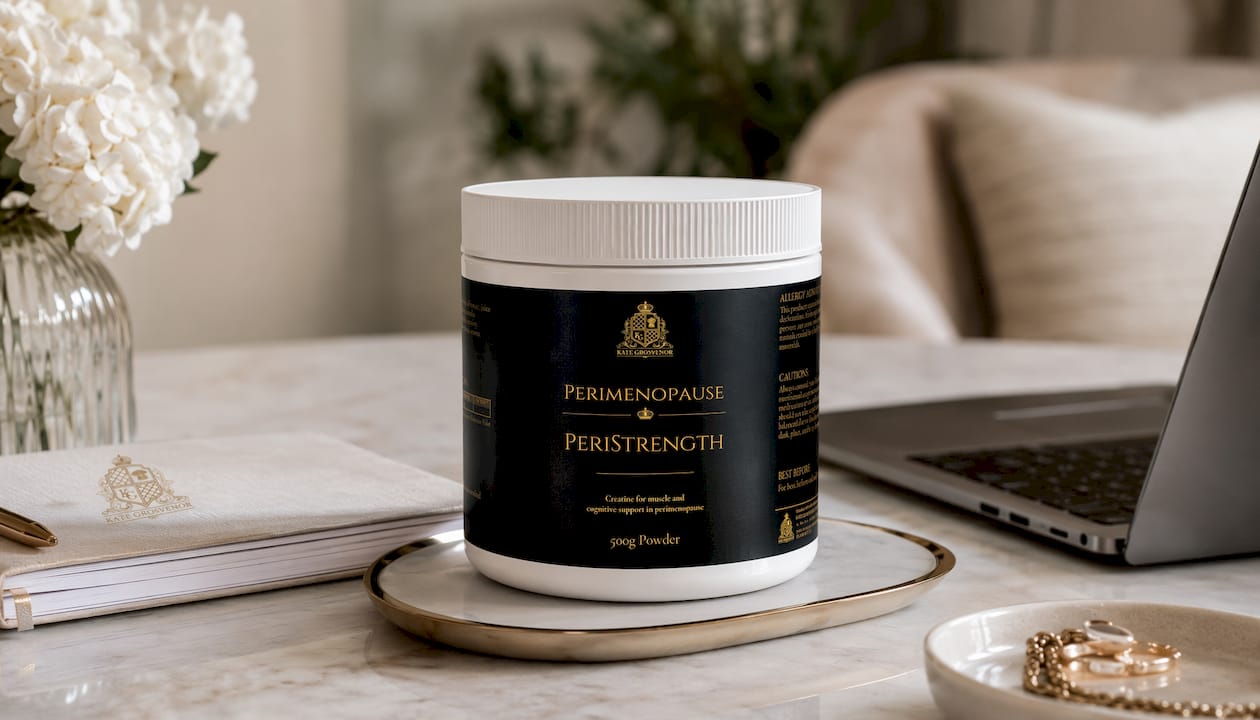
Pair it with a quality collagen powder chosen for purity and dose, and you have a simple, science-backed daily ritual that works quietly in the background while you get on with living. No complicated protocols. No rigid timing windows. Just two well-chosen supplements, taken consistently, as part of a routine that feels like care rather than effort.
Visit Kate Grosvenor Lifestyle to explore PeriStrength and find the collagen that fits your life.



Leave a comment
This site is protected by hCaptcha and the hCaptcha Privacy Policy and Terms of Service apply.