
Perimenopause sleep disturbances: what to try tonight
Perimenopause commonly disrupts sleep, and for most women, that disruption has a name and a reason behind it. Falling and fluctuating oestrogen, alongside declining progesterone, unsettle the systems that once let you drift off and stay asleep. That is not a small thing, and it is not something to simply endure until it passes.
Tonight, though, there is a place to start. Cool the bedroom. Choose breathable bedding. Give yourself a short, unhurried wind-down before you turn out the light. These are the first, gentlest anchors you can put down, and they matter more than you might expect.
Begin here:
- Lower the bedroom temperature and remove heavy layers, even if the rest of the house runs warm.
- Swap synthetic sheets and nightwear for cotton, linen, or bamboo, which breathe rather than trap heat.
- Give yourself a 20 to 30 minute wind-down before bed. Dim lighting, no screens, something calming rather than stimulating.
- Start a simple sleep and symptom diary tonight, noting bedtime, waking times, night sweats, and how rested you feel.
Estimates vary, but reviews suggest that somewhere between roughly 40% and 64% of women experience sleep problems as they move through the menopausal transition, and sleep disturbances during this stage can include insomnia, sleep-disordered breathing, and restless legs syndrome. If your sleep has been troubled for more than a few months, or it is genuinely affecting your days, that is a reasonable point to bring it to your GP rather than wait it out alone.
Key Takeaways
Perimenopause sleep disturbances stem mainly from fluctuating oestrogen and falling progesterone, and most women improve with a combination of environmental changes, behavioural routine, and, where appropriate, medical treatment.
| Point | Details |
|---|---|
| Identify your pattern first | Note whether your issue is falling asleep, waking repeatedly, waking too early, or experiencing night sweats. |
| Cool the bedroom tonight | Breathable bedding, lighter nightwear, and a cooler room reduce night sweat wake-ups quickly. |
| Build a consistent wind-down | A 30 to 60 minute routine with a fixed wake time anchors a hormonally unsettled body clock. |
| See your GP after three months | Persistent disruption, daytime impairment, or drenching sweats with weight loss warrant review. |
| Discuss CBT-I and HRT with your GP | Both are evidence-backed; the right choice depends on your history and symptom severity. |
| Support routines with the right ritual | The Sleep & Calm Ritual and Hormone Balance & Mood Ritual from Kate Grosvenor Lifestyle are designed to sit alongside behavioural and clinical care. |
Table of Contents
- What kind of sleep problem are you actually dealing with?
- Why does hormonal change disrupt sleep so directly?
- What else could be worsening your sleep besides hormones?
- How can you reduce night sweats tonight?
- What nightly routine actually helps you sleep better?
- Which treatments actually work, and how do you choose?
- When should you actually see your GP about this?
- Where do rituals and supplements fit alongside medical care?
- Can what you eat actually change how well you sleep?
- Does perimenopause make stress feel harder to switch off at night?
- Does exercise help or hinder perimenopause sleep?
- Where can you read more on this?
- What the evidence actually tells us to prioritise
- How Kate Grosvenor Lifestyle supports better sleep in perimenopause
- Frequently asked questions about perimenopause sleep disturbances
- Sources
What kind of sleep problem are you actually dealing with?
Perimenopause insomnia rarely shows up as one single pattern. It tends to arrive in one of several distinct shapes, and knowing which one you are living with helps you and your GP focus on the right fix rather than a generic one.
- Sleep-onset insomnia: lying awake for 30 minutes or more before drifting off, mind often racing.
- Sleep-maintenance insomnia: falling asleep without much trouble, then waking repeatedly through the night, often around the same hours.
- Early-morning waking: surfacing at 4am or 5am and being unable to get back to sleep, even when exhausted.
- Fragmented, non-restorative sleep: technically sleeping enough hours, but waking feeling as though you never properly rested.
- Night sweats and hot flashes: sudden heat surges that jolt you awake, sometimes several times a night.
- Restless legs and periodic limb movements: an uncomfortable urge to move the legs that disrupts settling or re-settling.
- Obstructive sleep apnoea: pauses in breathing during sleep, more easily missed in women because the presentation is often fatigue and low mood rather than obvious snoring.
Sleep disturbance during perimenopause and menopause is genuinely common rather than a personal failing. A narrative review of sleep disturbances in menopause found that women in this stage tend to have lighter, more fragmented sleep, more time spent awake after initially falling asleep, and a higher overall prevalence of insomnia and sleep-disordered breathing than they had before.
Prevalence at a glance: Depending on the study population and how sleep problems were measured, reviews cite figures ranging from around 40% up to 64% of women reporting disrupted sleep through the menopausal transition. Most women see meaningful improvement once the right treatment or lifestyle change is in place, and many find symptoms ease further once they move past perimenopause into established menopause.
| Sleep pattern or measure | Reported estimate |
|---|---|
| Women reporting sleep problems during the transition | Roughly 40% to 64% |
| Increased odds of disruption with depression | Higher odds |
| Increased odds of disruption with hot flashes | Higher odds |
| Increased odds of disruption with psychotropic medication use | Higher odds |
Why does hormonal change disrupt sleep so directly?
Progesterone is the hormone most directly tied to easy sleep, and its decline during perimenopause is one of the clearest reasons sleep becomes harder to hold onto. Progesterone has a naturally sedating, calming effect on the brain. As levels fall, and as oestrogen swings unpredictably rather than declining smoothly, the internal signals that once ushered you into deep, continuous sleep become far less reliable.
The mechanism runs roughly like this:
- Oestrogen helps regulate the body’s internal thermostat, based in the hypothalamus.
- As oestrogen fluctuates and eventually withdraws, that thermostat becomes more easily triggered, producing sudden, intense heat surges.
- Those hot flashes and night sweats interrupt sleep directly, often jolting you from deeper stages into lighter, more easily disrupted sleep.
- Repeated interruptions night after night gradually shift your sleep architecture towards more time awake and less time in the restorative slow-wave stages.
There is a curious detail here worth knowing: the brain often registers the wake-up trigger of a night sweat before you consciously feel the heat, which is one reason environmental cooling helps in the moment but doesn’t always solve the underlying pattern. A translational review of reproductive hormones across the female lifespan found that both oestradiol and progesterone play a role in maintaining stable sleep-wake cycles, and their decline can affect not just how long you sleep but how well that sleep supports memory and mood.
Pro Tip: Picture it as a simple chain: hormone fluctuation unsettles your internal thermostat, that thermostat triggers a heat surge, and the heat surge wakes you. Breaking the chain anywhere, whether through cooling your room, treating the hormonal driver, or calming the nervous system before bed, can shorten the disruption.
Left unaddressed over months or years, this pattern carries real weight. Poor sleep in midlife has been linked to memory difficulties, irritability, and reduced patience, and untreated sleep disturbance is associated with longer-term cardiometabolic and cognitive risk. This is why the earlier action point, cooling the room and tracking your pattern, is worth doing consistently rather than only on the worst nights.
What else could be worsening your sleep besides hormones?
Hormones rarely act alone. A 2025 meta-analysis of perimenopausal sleep disorders found that several other factors significantly raise the odds of disrupted sleep, and separating these from the purely hormonal picture matters because many of them are directly treatable.
- Depression and anxiety: the meta-analysis found depression significantly more likely to accompany disrupted sleep.
- Chronic disease: ongoing health conditions raised the odds of disrupted sleep.
- Psychotropic medication use: certain medications, including some antidepressants, were linked to higher odds of sleep disruption.
- Alcohol and late caffeine: both fragment sleep even when they seem to help you unwind or feel more alert during the day.
- Weight and waist circumference: linked to a higher risk of obstructive sleep apnoea, which is often under-diagnosed in women because it shows up as fatigue and low mood rather than loud snoring.
- Shift work and chronic stress: both erode the circadian rhythm that perimenopause is already destabilising.
These findings suggest that sleep disruption during this stage is rarely down to one single cause; it is usually two or three factors compounding each other. Before your next GP appointment, it helps to check a short list yourself:
- Medication review: are any current prescriptions, including antidepressants, known to disturb sleep?
- Mood screening: has your mood shifted alongside your sleep, and which came first?
- Sleep apnoea and restless legs screening: do you wake unrefreshed, snore, or feel an urge to move your legs at night?
- Blood tests where relevant: thyroid function and iron levels are worth ruling out if fatigue is prominent.
Pro Tip: Keep a simple diary for two to three weeks before your GP visit: bedtime, wake times, night sweats, mood, alcohol or caffeine intake, and any medication changes. A pattern that takes you months to notice can often be spotted by a GP in minutes once it’s written down.
How can you reduce night sweats tonight?
Environmental changes are the recommended first-line step for night sweats, and they are also the fastest to put in place. Clinical guidance recommends breathable nightclothes, lightweight bedding, and a cool bedroom before reaching for any prescription approach, and for many women, that alone takes the edge off.
Try this tonight:
- Set the bedroom temperature a few degrees cooler than feels automatically comfortable. You want it cool enough to notice, not merely mild.
- Switch to cotton, linen, or bamboo nightwear and bedding, layered so you can shed one without waking fully.
- Keep a glass of cold water and a small towel within reach.
- Use a fan, even a small one, positioned to move air across the bed rather than simply into the room.
- Avoid alcohol, spicy food, and vigorous evening exercise in the hours before bed, all of which can provoke a heat surge.
- If your weight has crept up, know that this is one of the more modifiable factors linked to both night sweats and sleep apnoea risk.
It is worth understanding that night sweats are not always purely menopausal. Certain medications, infections, and endocrine conditions can also cause them, so if the sweats are drenching, or paired with unexplained weight loss, fever, or persistent pain, that combination deserves a GP appointment rather than another cooling fan. When environmental steps are not enough and hormone therapy is unsuitable for you, there are also non-hormonal prescription options worth discussing with your GP, which the treatments section below covers in more depth.
What nightly routine actually helps you sleep better?
A consistent sleep schedule paired with a genuine 30 to 60 minute wind-down is the single most reliable behavioural change you can make, more reliable than almost any single supplement or gadget. Perimenopause insomnia responds well to routine precisely because your internal clock is already under strain from hormonal noise. Giving it predictable cues helps compensate.
A workable nightly rhythm might look like this:
- 90 minutes before bed: dim household lighting and step away from bright screens, or use night mode if you must use one.
- 60 minutes before bed: begin your wind-down. A warm bath, gentle stretching, or reading on paper rather than a screen all work well.
- 30 minutes before bed: try a short breathing exercise or a few minutes of quiet mindfulness. Slow, deliberate breathing genuinely calms the nervous system before sleep.
- At bedtime: go to bed only when sleepy, not simply because the clock says so.
- If you wake and cannot resettle within 20 minutes: get up, keep the lights low, do something quiet and boring, then return to bed once drowsy again. This is a core principle of stimulus control, and it stops the bed becoming associated with wakeful frustration.
Some habits help more than they seem to, and others quietly work against you even when they feel soothing in the moment.
- Helps: a fixed wake-up time every day, including weekends, which anchors your circadian rhythm far more than a fixed bedtime does.
- Hurts: a nightcap. A small alcohol intake might ease you into sleep faster, but it reliably fragments sleep maintenance later in the night.
- Helps: morning daylight exposure, ideally within an hour of waking, which reinforces your body clock.
- Hurts: checking the time repeatedly during a wakeful spell, which increases anxiety and makes resettling harder.
If insomnia has become a nightly, months-long pattern rather than an occasional bad night, cognitive behavioural therapy for insomnia, known as CBT-I, is the recommended first-line treatment, and the next section explains why.
Which treatments actually work, and how do you choose?
CBT-I and addressing the vasomotor symptoms driving your night waking are the two most evidence-backed routes through perimenopausal sleep disturbance, and for many eligible women, hormone therapy meaningfully improves sleep, though it requires a proper conversation with your GP about your own risk profile rather than a blanket recommendation.
CBT-I works by retraining the associations and habits around sleep, using stimulus control, restricting time in bed to time actually spent asleep, and addressing the anxious thoughts that build up around not sleeping. It has no drug interactions and no withdrawal period, which makes it a sensible starting point for most women regardless of what else is going on hormonally.
Hormone replacement therapy, typically combined oestrogen and progestogen for women with a uterus, treats the underlying vasomotor symptoms rather than just masking them, and progesterone specifically tends to bring a sedating benefit of its own. It is not right for every woman, and the decision genuinely needs to be shared between you and your GP, weighing your personal and family medical history.
| Treatment approach | How it works | Typical duration | Key safety notes |
|---|---|---|---|
| CBT-I | Retrains sleep habits and reduces anxiety around wakefulness | Usually 4 structured sessions | Minimal risk; widely considered first-line for chronic insomnia |
| Menopausal hormone therapy | Addresses hormonal drivers of hot flashes and night waking directly | Ongoing, reviewed regularly with your GP | Requires individual risk assessment; not suitable for everyone |
| Non-hormonal prescription options (SSRIs/SNRIs, gabapentin) | Reduce vasomotor symptom frequency through non-hormonal pathways | Ongoing, under GP review | Possible side effects and interactions; useful when HRT is unsuitable |
| Short-term hypnotics | Sedate directly to promote sleep onset | Short courses only, typically days to weeks | Risk of dependence and next-day grogginess with longer use |
| Melatonin and magnesium | Support circadian signalling and general relaxation | Ongoing, low-risk for most people | Generally well tolerated; check with your GP if on other medication |
Before any GP conversation, it helps to have a few points ready:
- How long you’ve had disrupted sleep, and whether it’s onset, maintenance, or early waking.
- The frequency and severity of hot flashes or night sweats.
- Any personal or family history relevant to HRT, including clotting disorders or hormone-sensitive conditions.
- Current medications and supplements, including anything psychotropic.
- Whether you smoke, and your current weight trend, both of which affect treatment suitability.
Remember the earlier figures: depression raised the odds of sleep disruption by around 2.73 times and psychotropic medication use by around 3.19 times in the meta-analysis mentioned above. That is worth mentioning to your GP directly, because treating an underlying mood issue sometimes resolves the sleep problem as a side effect, rather than the other way around.
When should you actually see your GP about this?
See your GP if disrupted sleep has lasted three months or more, is affecting your daytime functioning, or comes with red flags such as drenching night sweats alongside unexplained weight loss, or loud snoring with breathing pauses and choking sounds. Those particular combinations deserve prompt review rather than another few weeks of waiting to see if it settles on its own.
A typical first appointment will usually involve:
- A review of your current medications, since several common prescriptions can disrupt sleep as a side effect.
- A brief mood screen, given how closely depression and anxiety intertwine with perimenopausal sleep problems.
- Basic blood tests, such as thyroid function, if your symptoms suggest it.
- Screening questions for restless legs syndrome and obstructive sleep apnoea, with referral for a sleep study if apnoea seems likely.
Clinicians are also trained to look for drenching sweats paired with weight loss or fever as signals to rule out causes other than menopause, including infections or thyroid conditions, before settling on a hormonal explanation.
Pro Tip: Bring a two-week sleep and symptom diary and a full list of your current medications, including any over-the-counter supplements. It turns a vague “I’m not sleeping well” into something your GP can actually work with in a ten-minute appointment.
Where do rituals and supplements fit alongside medical care?
Thoughtfully chosen rituals and supplements can support the behavioural steps already covered here, and for some women, they meaningfully improve sleep quality when used as part of a wider plan rather than as a replacement for medical care. That distinction matters: nothing here substitutes for the conversation with your GP outlined above.
Kate Grosvenor Lifestyle was built around exactly this stage of life, informed by the same evidence base running through this article: hormone fluctuation disrupts sleep architecture, thermoregulation drives night waking, and consistent nightly habits help settle both. The Sleep & Calm Ritual was formulated with that pattern specifically in mind, designed to be folded into the wind-down routine already recommended above rather than taken as a stand-alone fix.

For women whose sleep disruption seems closely tied to mood swings and hormonal volatility rather than heat alone, the Hormone Balance & Mood Ritual addresses that overlapping territory between mood and sleep quality that the meta-analysis findings above point to so clearly.
A sensible nightly ritual might combine:
- Your existing wind-down routine, roughly 30 to 60 minutes before bed.
- A consistent supplement timing, generally with your evening meal or shortly before your wind-down begins, checked against any other medication you take.
- Environmental cooling steps from earlier in this article if night sweats are a factor.
- A pause, and a check-in with your GP, if symptoms worsen or fail to improve after a reasonable trial period.
If you are pregnant, trying to conceive, or on regular medication, check with your GP or pharmacist before adding any new supplement, since interactions and contraindications vary by individual.
Can what you eat actually change how well you sleep?
What you eat in the hours before bed, and across the day, shapes sleep more directly than most women realise during perimenopause. Heavy, rich evening meals raise core body temperature at exactly the point you want it falling, which can provoke the same thermoregulatory triggers behind night sweats. A lighter evening meal, eaten a few hours before bed rather than right before it, tends to sit more comfortably with a cooling body.
Certain nutrients also play a supporting role. Magnesium is involved in nervous system regulation and muscle relaxation, which is part of why many women find a magnesium supplement useful as part of an evening routine. Omega-3 fatty acids, found in oily fish or taken as a targeted supplement, are more commonly associated with mood stability, and mood and sleep are closely linked during this stage, as the earlier meta-analysis findings on depression make clear.
Caffeine deserves particular attention. Its effects can linger for six hours or more, so a mid-afternoon coffee that felt harmless can still be interfering with sleep onset at 11pm. Alcohol, similarly, tends to help sleep onset while actively undermining sleep maintenance later in the night, which is worth remembering on the nights it feels like exactly what you need to switch off.
Does perimenopause make stress feel harder to switch off at night?
Perimenopause tends to amplify the effect ordinary stress has on sleep, partly because the same falling progesterone that once helped calm the nervous system is no longer doing that job as reliably. A stressful day that you might once have shrugged off can now translate directly into a wired, restless night, and that pattern often catches women off guard because it feels disproportionate to what actually happened.
This is not purely psychological. Hormonal volatility genuinely lowers your buffer against everyday stress, which is part of why depression and anxiety showed such a strong statistical link to sleep disruption in the meta-analysis referenced earlier in this article. The practical implication is that stress management during perimenopause deserves the same seriousness as bedroom temperature or sleep timing, rather than being treated as a separate, softer concern.
Simple, repeatable practices tend to work better here than anything elaborate. A short breathing exercise before bed, the kind already built into the nightly routine above, activates the parasympathetic nervous system directly. Journaling for five minutes to offload racing thoughts before you try to sleep can also reduce the mental rehearsal that so often keeps women awake at 2am. If stress and low mood feel like the dominant driver of your sleep problems rather than night sweats or hormonal timing alone, that is worth naming explicitly to your GP.
Does exercise help or hinder perimenopause sleep?
Regular moderate exercise improves sleep quality during perimenopause, but timing and intensity both matter more than they did in your twenties. Morning or early afternoon movement, whether brisk walking, swimming, or resistance training, tends to support better sleep that night by reinforcing your circadian rhythm and helping regulate the body’s core temperature cycle.
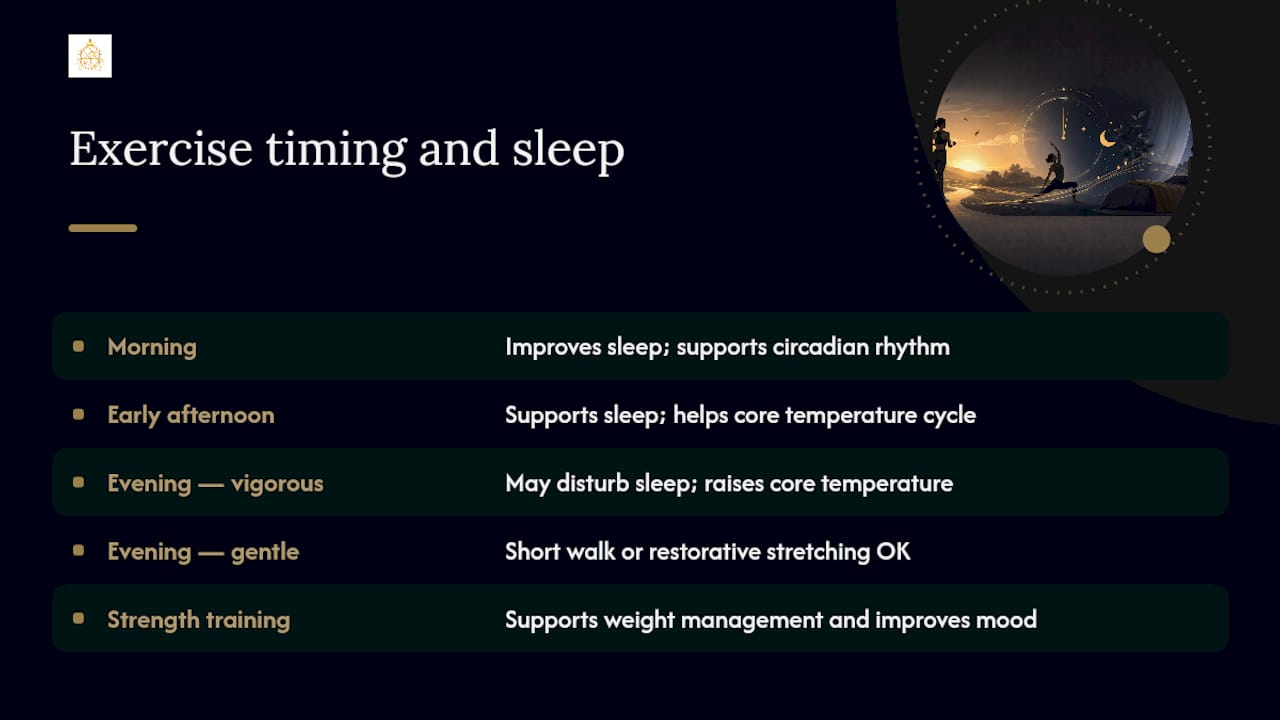
Evening exercise is where it gets more nuanced. Vigorous workouts within a couple of hours of bedtime can raise core temperature and heart rate at precisely the point your body should be winding down, potentially triggering the same kind of heat-related waking as a heavy meal or a glass of wine too close to bedtime. Gentler evening movement, such as a short walk or restorative stretching, tends to sit far more comfortably with sleep.
Strength training deserves a specific mention here, since it supports the same weight management that reduces the risk of obstructive sleep apnoea covered earlier in this article. Building and maintaining muscle mass through perimenopause also tends to improve mood, which loops back into the depression and anxiety link found in the meta-analysis of sleep risk factors. Exercise will not undo a genuinely disrupted hormonal pattern on its own, but it is one of the more consistently useful levers available to you, alongside everything else covered here.
Where can you read more on this?
- Sleep and hormones, for a clear overview of how perimenopause affects sleep-disordered breathing and restless legs syndrome.
- Perimenopause and sleep disorders: meta-analysis, for the strongest available data on which risk factors most increase sleep disruption.
- Night sweats, for practical NHS guidance on managing symptoms and knowing when to seek review.
- Sleep disturbances in menopause: review and clinical implications, for a broader clinical review of sleep architecture changes.
- How does menopause affect my sleep?, for a practical explanation of cognitive and emotional consequences.
- What causes night sweats?, for prevalence data and general causes worth understanding.
What the evidence actually tells us to prioritise
The conventional advice on perimenopause sleep disturbances tends to jump straight to hormone therapy or straight to lavender pillow spray, skipping the middle ground where most of the real progress happens. That middle ground is unglamorous: a cooler room, a fixed wake time, a genuine wind-down, and an honest conversation about what else, medication, mood, or weight, might be compounding the problem.
What gets underestimated most is how much the combination of factors matters more than any single one. The meta-analysis figures cited throughout this article are stark on their own, depression nearly tripling the odds of disruption, psychotropic medication use more than tripling it, but they rarely act in isolation. A woman dealing with night sweats, mild anxiety, and two glasses of wine most evenings is not facing one problem with one fix. She is facing three, and untangling them usually matters more than finding the single “right” treatment.
If there is one place to start, it is tracking before treating. A fortnight of honest notes on sleep, sweats, mood, and habits will tell you and your GP more than any single symptom description could, and it turns a vague sense of “I’m just not sleeping” into something genuinely actionable.
How Kate Grosvenor Lifestyle supports better sleep in perimenopause
Once you know which pattern you’re dealing with, cooling your room, building a wind-down, ruling out other causes with your GP, the next question is usually what to actually put in your evening routine that supports the process rather than complicates it.

Kate Grosvenor Lifestyle was built specifically around this stage of life, which means every product is formulated with the mechanisms covered in this article in mind, not as a generic wellness add-on. The Sleep & Calm Ritual was designed to slot directly into the wind-down routine outlined earlier, giving your evening a consistent anchor rather than one more thing to remember. If mood swings and hormonal volatility feel like the bigger driver behind your disrupted nights, the Hormone Balance & Mood Ritual addresses that overlapping territory between emotional wellbeing and sleep quality directly.
Both sit comfortably alongside whatever your GP recommends, whether that’s CBT-I, HRT, or simply time to let your body settle into its new rhythm. If night sweats specifically are your main disruptor, the PeriCool cooling support is worth a look too. Visit Kate Grosvenor Lifestyle today to explore the full ritual range and find the one that matches your particular pattern of disrupted sleep.
Frequently asked questions about perimenopause sleep disturbances
Can perimenopause really affect sleep quality this much? Yes. Falling and fluctuating hormone levels destabilise both temperature regulation and the sleep-wake cycle itself, and reviews suggest between 40% and 64% of women experience disrupted sleep through this transition.
Why is sleep disrupted in perimenopause specifically, rather than just getting worse with age generally? The mechanism is hormone-specific. Progesterone’s natural sedating effect declines, while oestrogen fluctuation destabilises the hypothalamic thermostat, directly triggering the hot flashes and night sweats that fragment sleep.
How long do perimenopause sleep problems usually last? This varies significantly by individual, but many women see improvement once treatment, whether behavioural, hormonal, or non-hormonal, is in place, and symptoms often ease further once perimenopause resolves into established menopause.
Should I try melatonin or magnesium before seeing my GP? Both are generally well tolerated for most people, but check with your GP or pharmacist first if you take other medication, and don’t let a supplement delay a GP visit if your symptoms have lasted three months or more.
Is HRT the only effective treatment for perimenopause insomnia? No. CBT-I is considered a first-line treatment for chronic insomnia with strong evidence behind it, and non-hormonal prescription options exist for women who cannot or choose not to take HRT.
This article provides general information and is not a substitute for personalised medical advice. Speak to your GP about any persistent sleep disturbance or before starting a new supplement or treatment.
Sources
- Sleep and hormones
- Perimenopause and sleep disorders: meta‑analysis
- Night sweats
- How does menopause affect my sleep?
- Sleep disturbances in menopause: review and clinical implications
- What causes night sweats?


Leave a comment
This site is protected by hCaptcha and the hCaptcha Privacy Policy and Terms of Service apply.