
Marine vs bovine collagen: which is right for you?
Marine collagen tends to suit skin-focused goals; bovine collagen offers broader structural support, including type III collagen for joints, bone, and connective tissue. That said, the degree of hydrolysis and resulting peptide size often matters more than the source alone. A well-hydrolysed bovine product with peptides under 3,000 Daltons can absorb just as efficiently as a typical marine formula.
Quick guide: who tends to suit which source
- Skin, hair, and nails: marine collagen, for its smaller peptide size and type I predominance
- Joints, bone, and connective tissue: bovine collagen, for its type I and type III content
- Gut health and muscle recovery: either source works; prioritise hydrolysis quality
- Perimenopause and midlife structural support: bovine’s type III content can be particularly relevant
- Fish allergy: choose bovine; avoid marine entirely
- Halal or kosher requirements: check certification; marine from certified sources or halal-certified bovine
- Vegetarian or vegan: neither source is plant-based; consider a vegan omega supplement as a complementary option
Before you buy, check three things: molecular weight (aim for under 3,000 Daltons), third-party testing certificates, and whether the formula includes Vitamin C to support your body’s own collagen synthesis.
Table of Contents
- What is bovine collagen and how is it made?
- What is marine collagen and where does it come from?
- How do marine and bovine collagen compare side by side?
- Which collagen suits your specific goals?
- How to take collagen safely and what to watch for in the UK
- Why targeted collagen formulas matter in midlife
- Key takeaways
- The collagen choice I keep coming back to
- Perimenopause Premium Collagen Peptides: a considered choice for midlife women
- Useful sources and further reading
What is bovine collagen and how is it made?
Bovine collagen comes from cattle, typically extracted from cowhide, bones, and cartilage. Cowhide and bone yield predominantly type I and type III collagen; cartilage-derived products may also contain type II, which is associated with joint cushioning. This breadth of collagen types is one of bovine’s practical strengths.
Processing involves denaturation followed by enzymatic hydrolysis, which breaks the collagen protein into smaller, bioavailable peptides. Bovine collagen has higher thermal stability than marine collagen, owing to its greater hydroxyproline and proline content. This means more rigorous hydrolysis is needed to reach smaller peptide sizes. Commercial bovine peptides typically fall in the 3,000–8,000 Dalton range, though well-processed products can achieve lower molecular weights.
In the UK, bovine collagen powder and capsules are widely available and often more affordable than marine equivalents. Allergen considerations are straightforward: bovine is suitable for those with fish allergies, though it is not appropriate for vegetarians, vegans, or those requiring halal or kosher certification without explicit labelling.
What to look for on the label:
- The words “hydrolysed collagen” or “collagen peptides” (not simply “collagen”)
- Molecular weight stated in Daltons (lower is generally better for absorption)
- A Certificate of Analysis (CoA) from a third-party laboratory
- Clear sourcing information: grass-fed, farm-audited, or equivalent transparency
Pro Tip: If a bovine product does not state its molecular weight or offer a CoA on request, that is a signal to look elsewhere. Reputable brands make this information easy to find.
What is marine collagen and where does it come from?
Marine collagen is extracted from fish, most commonly from the skin and scales of species such as cod, tilapia, and salmon. These parts are by-products of the fishing industry, which means a well-sourced marine collagen can make use of material that would otherwise go to waste. The result is predominantly type I collagen, the most abundant collagen in human skin, making it a natural fit for skin-targeted supplementation.

Fish collagen has lower thermal stability than bovine collagen, due to fewer proline and hydroxyproline residues. This actually works in its favour during processing: it hydrolyses more readily into smaller peptides. Marine collagen peptides typically have smaller molecular weights, which contributes to faster intestinal absorption compared with many bovine products. Absorption of hydrolysed marine collagen is up to 1.5 times more efficient than that of collagen fragments from land mammals.
Key considerations for marine collagen:
- Fish allergy: marine collagen is derived from fish and must be avoided by anyone with a fish allergy
- Halal and kosher: suitability depends on the species and certification; always check the label
- Sustainability: look for MSC certification or equivalent traceability; not all marine collagen is sustainably sourced
- Price: marine collagen typically carries a slightly higher retail price in the UK than bovine equivalents
- Availability: widely stocked in UK health retailers and online, though quality varies considerably
How do marine and bovine collagen compare side by side?
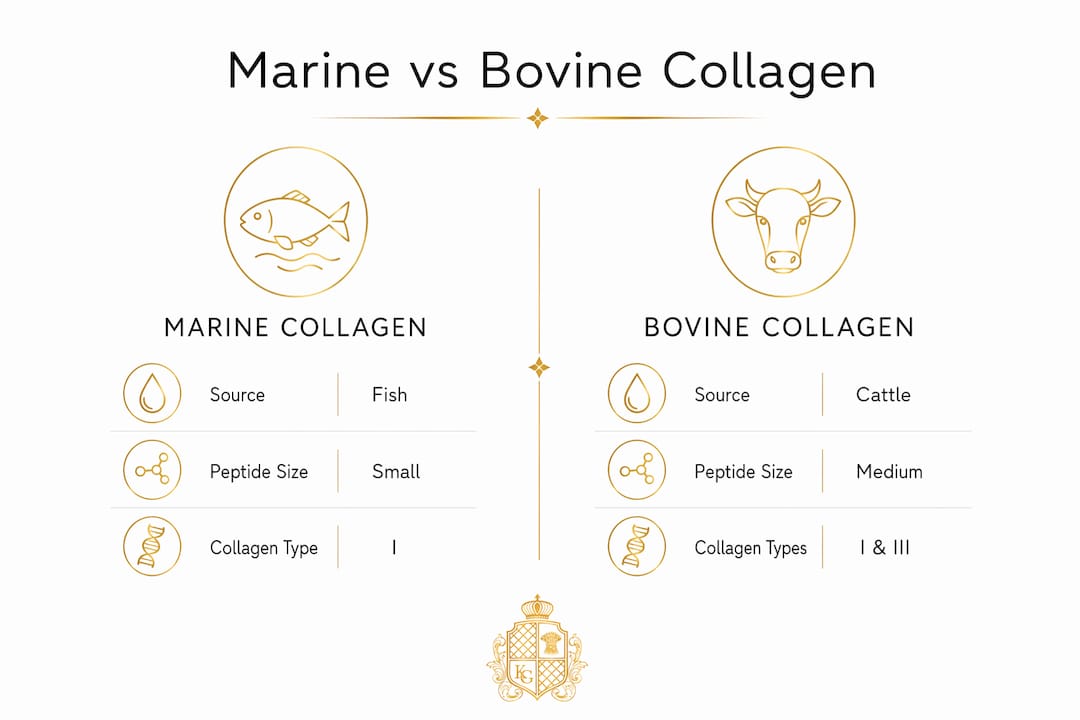
The difference between marine and bovine collagen comes down to source, peptide size, collagen types present, and how well the product has been processed. Neither source is categorically superior; the right choice depends on your goal and the quality of the specific product.
| Dimension | Marine collagen | Bovine collagen |
|---|---|---|
| Source | Fish skin and scales (cod, salmon, tilapia) | Cowhide, bones, cartilage |
| Collagen types | Predominantly type I | Type I and type III (type II if cartilage-derived) |
| Typical peptide size | 2,000–3,000 Daltons | 3,000–8,000 Daltons |
| Bioavailability | Generally faster absorption due to smaller peptides | Comparable when well-hydrolysed to under 3,000 Da |
| Primary health uses | Skin elasticity, hair, nails | Joints, bone, connective tissue, skin |
| Allergen suitability | Not suitable for fish allergy | Suitable for fish allergy; not suitable for vegans |
| Dietary suitability | Check halal/kosher certification by species | Check halal/kosher certification; not vegetarian |
| Sustainability | Can use fishery by-products; requires MSC traceability | Depends on farm sourcing and audit transparency |
| UK price (typical) | Higher per serving | More affordable and widely available |
| Common formats | Powder, capsules | Powder, capsules, liquid |
What each row means in practice:
- Peptide size is the single most important metric. Marine collagen peptides are typically 2,000–3,000 Daltons, while bovine collagen peptides are usually 3,000–8,000 Daltons unless well-hydrolysed. Smaller peptides are transported across the intestinal wall more efficiently, meaning more collagen reaches your bloodstream in bioactive form.
- Type III collagen matters in midlife. It supports connective tissue and skin structure alongside type I, and its presence in bovine collagen makes it a versatile choice when joint and skin support are both priorities.
- Sustainability claims require evidence. Marine collagen can be an environmentally efficient use of fishery by-products, but only when sourcing is traceable. Look for MSC certification or equivalent.
- Clinical evidence shows both sources can support skin elasticity and joint comfort; no consistent head-to-head superiority has been established across outcomes.
Which collagen suits your specific goals?
Choosing between marine and bovine collagen is less about which is “better” and more about which fits your body’s current needs. Here is how to think through the most common scenarios.
Skin, hair, and nails: Marine collagen’s smaller peptides and type I predominance make it a natural first choice. If skin is your primary goal and you have no fish allergy, a well-hydrolysed marine product is worth prioritising.
Joints, bone, and connective tissue: Bovine collagen, with its type I and type III content, tends to offer broader structural support. For anyone managing joint discomfort or focused on bone density, bovine is the more versatile option. Pairing it with Vitamin D3 and K2 can further support bone health.

Perimenopause and midlife: During the Renewal Years, collagen production declines and the body often needs simultaneous support for skin, joints, and connective tissue. Bovine’s inclusion of type III collagen makes it particularly relevant here. A targeted formula that combines both types, with added Vitamin C, addresses several needs at once.
Gut health and muscle recovery: Either source can contribute. What matters most is hydrolysis quality and consistent daily use alongside adequate protein intake.
Dietary and cultural constraints:
- Fish allergy: bovine only
- Halal or kosher: seek certified products from either source
- Vegetarian or vegan: neither marine nor bovine collagen is plant-based; no vegan collagen supplement currently has the same evidence base
Budget: Bovine collagen is generally more affordable and easier to find in UK health shops and online. If budget is a consideration, a well-hydrolysed bovine product often represents better value than a poorly processed marine one at a higher price.
Pro Tip: Some premium formulas combine marine and bovine collagen to cover both type I and type III in a single serving. If you want skin and structural support without taking two separate products, a multi-source formula can be a practical middle ground. Check that both sources are third-party tested.
How to take collagen safely and what to watch for in the UK
Most clinical studies use daily doses of 2.5–10 grams of hydrolysed collagen peptides, with skin-focused trials often sitting at the lower end and joint or bone studies using higher amounts. Powder formats dissolve easily in water, smoothies, or warm drinks; capsules suit those who prefer a fixed dose without measuring. You can even stir collagen powder into a chocolate collagen bliss mousse if you prefer something more indulgent.
Vitamin C pairing: Vitamin C is a cofactor in collagen synthesis, meaning your body needs it to build new collagen from the amino acids that supplemental peptides provide. Taking collagen alongside a Vitamin C-rich food or a supplement that includes Vitamin C is a simple, evidence-informed habit. Many quality formulas now include Vitamin C for this reason.
Safety and contraindications:
- Pregnancy and breastfeeding: consult your GP or midwife before starting any new supplement; collagen products are not routinely assessed for safety in pregnancy
- Fish allergy: marine collagen must be avoided; always read the full ingredient list, as some products blend sources
- Drug interactions: no widely documented interactions, but if you take anticoagulants or have a kidney condition, check with your GP before adding high-protein supplements
- Heavy metals: fish-derived collagen can theoretically accumulate environmental contaminants. Reputable manufacturers use purification processes that reduce this risk, and marine collagen sourced from clean fisheries with rigorous testing has been shown to be free of significant heavy metal contamination
Checking purity in the UK:
- Request or download the Certificate of Analysis (CoA) from the brand’s website
- Look for testing by an accredited UK or EU laboratory
- Check for heavy metals, microplastics, and microbial contamination in the CoA
- Confirm the product complies with UK Food Standards Agency guidelines for food supplements
Oral collagen hydrolysate has been shown to produce dose-dependent increases in hydroxyproline in human plasma, confirming that peptides survive digestion and reach the bloodstream in bioactive form. This is the mechanism that underpins the clinical rationale for supplementation.
Why targeted collagen formulas matter in midlife
Collagen production declines with age, and the pace of that decline accelerates during perimenopause as oestrogen levels fall. Oestrogen plays a direct role in stimulating collagen synthesis in the skin and connective tissue, so the years between 40 and 60 are often when women first notice changes in skin firmness, joint comfort, and hair texture simultaneously.
A targeted collagen formula for this life stage does more than simply provide collagen peptides. It considers which collagen types are most relevant (type I for skin, type III for connective tissue), the molecular weight of the peptides, and the co-factors that support your body’s own synthesis. For women in their Renewal Years, this kind of thoughtful formulation can make a real difference to how consistently the supplement supports daily wellbeing.
Trust signals to look for in any reputable collagen product:
- Molecular weight stated clearly (ideally under 3,000 Daltons)
- Third-party laboratory testing with a downloadable CoA
- Transparent sourcing: MSC certification for marine, farm-audit information for bovine
- Vitamin C included or recommended alongside
- Clear dosage guidance and contraindication information
- Compliance with UK Food Standards Agency supplement regulations
Kate Grosvenor Lifestyle’s Perimenopause Premium Collagen Peptides is formulated with these criteria in mind, combining hydrolysed collagen peptides with Vitamin C and transparent sourcing, specifically for women navigating perimenopause and menopause.
Key takeaways
The single most important factor when choosing between marine and bovine collagen is not the source itself but the degree of hydrolysis: a well-processed product with low molecular weight peptides will absorb more efficiently and deliver more consistent results than a poorly hydrolysed one from either source.
| Point | Details |
|---|---|
| Peptide size over source | Aim for under 3,000 Daltons; marine collagen peptides are typically 2,000–3,000 Daltons and well-hydrolysed bovine products under 3,000 Daltons can match their absorption. |
| Match to your goal | Marine suits skin and hair; bovine suits joints, bone, and midlife structural support. |
| Allergen and diet check | Fish allergy means bovine only; neither source is vegetarian or vegan. |
| Always pair with Vitamin C | Vitamin C is needed for collagen synthesis; choose a formula that includes it or pair deliberately. |
| Kate Grosvenor Lifestyle | Perimenopause Premium Collagen Peptides combines hydrolysed peptides, Vitamin C, and transparent sourcing for midlife women. |
The collagen choice I keep coming back to
There is a tendency in the wellness world to frame marine versus bovine as a clear-cut contest, with marine collagen cast as the more sophisticated, bioavailable option. The science is more nuanced than that. Processing quality is the real variable. A thoughtfully hydrolysed bovine formula can be just as absorbable as a marine one, and for women in midlife who need simultaneous support for skin, joints, and connective tissue, bovine’s type III content is genuinely useful in a way that a type-I-only marine product simply is not.
What I find most overlooked in this conversation is the importance of co-factors. Collagen peptides provide the raw material, but your body still needs Vitamin C, adequate sleep, and consistent daily use to translate that into visible, felt results. The supplement is one part of a wider rhythm of care.
My honest recommendation: prioritise third-party testing and molecular weight over the source debate. Then match the type to your goal. And if you are in your 40s or 50s and want a formula that has already done that thinking for you, a targeted midlife blend is worth the investment.
Perimenopause Premium Collagen Peptides: a considered choice for midlife women
If you have read this far, you already know that the right collagen supplement is not simply the most expensive or the most marketed one. It is the one that meets the criteria: low molecular weight peptides, the right collagen types for your goals, Vitamin C included, and sourcing you can verify.
Kate Grosvenor Lifestyle’s Perimenopause Premium Collagen Peptides is formulated specifically for women in their 40s and 50s, with hydrolysed collagen peptides, added Vitamin C, and transparent sourcing. It addresses the skin, joint, and connective tissue needs that tend to converge during perimenopause, without unnecessary fillers or vague label claims. If you are ready to build a consistent supplement routine, the Essentials Perimenopause Bundle pairs the collagen with complementary nutrients for a grounded, complete daily ritual. A supplement tracker can help you stay consistent and notice what is working over time. Visit the product page to read the full ingredient list, sourcing details, and testing information.
Useful sources and further reading
These sources underpin the claims in this article and offer a solid starting point if you want to read the evidence for yourself.
- Marine-Derived Collagen as Biomaterials for Human Health (PMC) — covers marine collagen sources, extraction methods, safety considerations including BSE risk, and sustainability of fishery by-products
- Hydrolyzed Marine Collagen: Emerging Evidence of Benefits via the Oral Route (PMC) — detailed review of bioavailability, peptide size advantages, and absorption mechanisms for marine collagen
- Effect of Orally Administered Collagen Peptides from Bovine Bone on Skin Aging (PMC) — clinical study on bovine bone collagen peptides and their effects on skin laxity and collagen fibre quality in aged skin
- Collagen Peptide Supplementation: Systematic Review (PMC) — systematic review of collagen peptide supplementation for body composition, collagen synthesis, and joint recovery
- The Nutrition Source: Collagen (Harvard T.H. Chan School of Public Health) — accessible overview of dietary collagen sources and the role of co-factors in endogenous synthesis
- Marine Collagen vs Bovine Collagen: How Sources Compare (RethinkPeptides) — practical comparison of peptide sizes, hydrolysis, and absorption differences
- Marine Collagen vs Bovine: Which Is Better? (Verywell Health) — balanced clinical overview including Vitamin C synergy and head-to-head evidence gaps
- What Is Marine Collagen? (WebMD) — consumer-facing summary of marine collagen sources, sustainability, and uses
- Bovine Collagen: Benefits, Forms, and Uses (Healthline) — overview of bovine collagen types, typical uses, and UK market availability
- Natural Health Versus Western Medicine: 2026 Guide — useful context on integrative health approaches for readers weighing supplement strategies alongside conventional care



Leave a comment
This site is protected by hCaptcha and the hCaptcha Privacy Policy and Terms of Service apply.